
01 — Overview
This campaign project positions IKEA Singapore not just as a furniture retailer, but as a relational problem-solver. In high-density urban environments, physical clutter frequently translates into emotional friction. By bridging the gap between home organization and family dynamics, IKEA introduces "I Need My Space"—a strategic, behavior-driven campaign designed to transform household conflict into creative collaboration, establishing long-term brand loyalty with the next generation of consumers.
02 — The Challenge
In compact Singaporean households (such as HDB flats and tight condominiums), physical space constraints significantly heighten emotional stress. Over 75% of parents frequently nag their teenagers about untidy rooms.
The traditional home organization market speaks almost exclusively to adults, entirely leaving teenagers out of the conversation. This creates a destructive cycle: parental nagging breeds resistance rather than motivation, and a messy room becomes a battleground. The core challenge is a psychological misalignment: teenagers view their bedrooms as a fundamental reflection of their identity and autonomy, while parents view those same rooms as shared household property that demands cleanliness.
03 — The Insight
"I Need My Space"
IKEA: Helping Families Find Space—Physically & Emotionally.
The strategic approach flips the script: instead of parents forcing organisation onto their children, IKEA empowers teenagers to take active charge of their own environment, giving parents peace of mind and a reason to stop nagging. By reframing a tidy room as the key to gaining more trust and freedom ("Neat room = No more naggy parent"), IKEA links spatial organisation with positive emotional rewards.


05 — The Experience
The campaign rolls out across a multi-stage ecosystem designed to capture attention, rephrase the family dialogue, and provide functional utility:
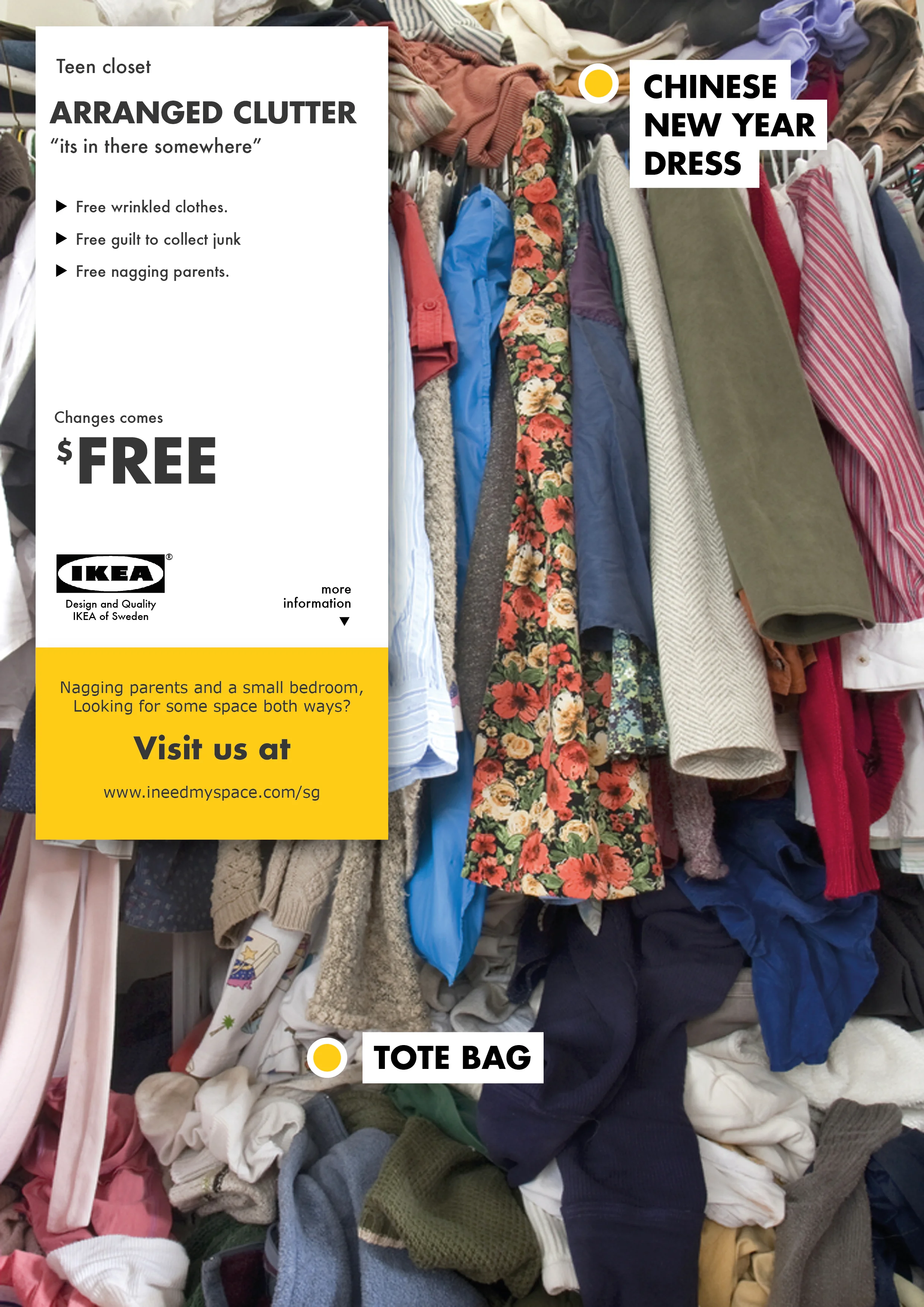
Awareness (Print & OOH): Relatable, humorous MRT and bus stop posters call out to frustrated teens to share photos of their messy rooms and stories of parental nagging using #INeedMySpace for a chance to win a complete room makeover. Visuals artfully showcase chaotic rooms layered with hidden clutter that only teens truly understand.
Engagement (Microsite & Direct Mailer): A dedicated microsite acts as a constructive outlet for teens to vent and discover tailored solutions. Accompanying direct mailers include a unique tool: IKEA "rephrases" a teenager's raw rant into a gentle, diplomatic message for their parents. It includes a physical door tag that parents can sign and hang up as a visual contract—a sign of agreement supporting their teen's request for space autonomy.


Solution & Gamification (The App): The "I Need My Space" mobile app features a Parent-Teen Collaboration Planner to co-design rooms based on daily habits. It integrates gamified habit-tracking challenges where teens earn points for keeping their spaces tidy. These points convert into IKEA discounts redeemable for food and products.
Impact Sharing (Case Study Video): A poignant video series follows real Singaporean families transforming their physical spaces and documents the subsequent reduction in household tension.
06 — The Outcome
By tackling an authentic social challenge, IKEA redefines its brand equity from a furniture retailer to an essential relationship builder. The campaign successfully shifts perceptions, drives long-term behavioral change in teenagers, and provides families with tangible tools for conflict resolution. Ultimately, "I Need My Space" seeds the value of organization into the younger generation, ensuring that future homeowners associate IKEA with positive emotions, mutual respect, and harmony at home.
07 —Research and Sources
1. Parent-Adolescent Conflicts in Singapore
Communication Gaps: Organisation for Economic Co-operation and Development. (2022). Singapore student well-being survey results. The Straits Times. Link
Family Conflict and Adolescent Behaviour: Chew, P. K. H., & Tan, E. L. Y. (2013). Quality of parent-child relationship, family conflict, peer pressure, and drinking behaviours of adolescents in an Asian context: The case of Singapore. ResearchGate. Link
2. Space Constraints in Singaporean Households
Compact Living Spaces: 9 Creation. (2023). Common layout problems faced by homeowners in Singapore. 9 Creation Interior Design. Link
Multigenerational Living Challenges: Meng Design Co. (2023). Maximising comfort: Designing homes for multigenerational living in Singapore HDB flats. Link
3. Adolescents’ Need for Personal Space
Room Rights & Autonomy: Pickhardt, C. E. (2015). Room rights in adolescence. Psychology Today. Link